


Solvents
Reyoung Pharmaceutical Co., Ltd., established in 1966, is a modern comprehensive pharmaceutical company. Reyoung is given the title of National Trustworthy Company for Contract and Credit, Grade AAA Credit Company and Credit Company of Shandong Medical Industry. In the past 50 years, Reyoung inherits the mission "Reyoung Pharma., Benefit the public", insists the business concept "Innovation is the basis, Product quality is first". Never stop exploration and innovation, forging ahead with determination, and realizing the sustainable healthy development.
Why Choose Us
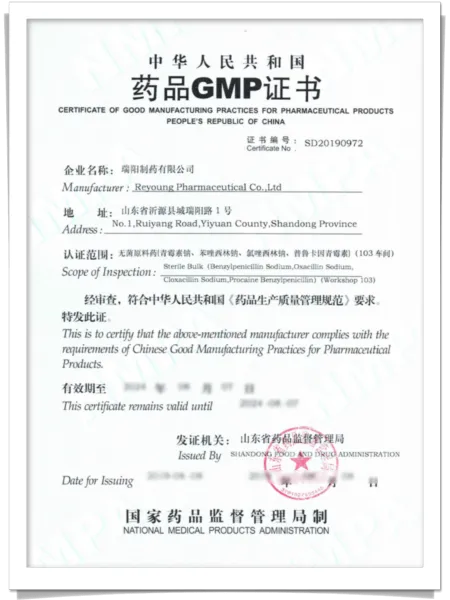
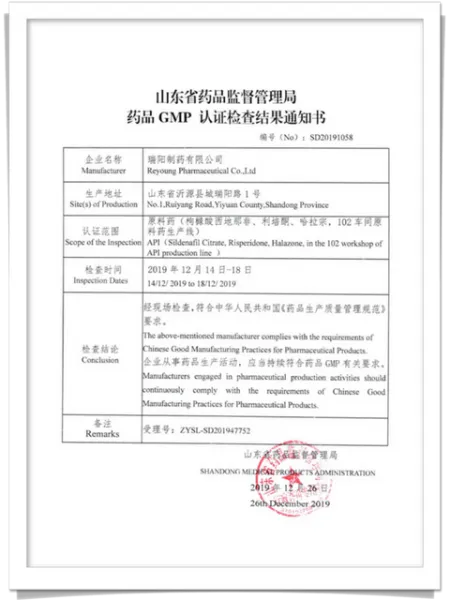
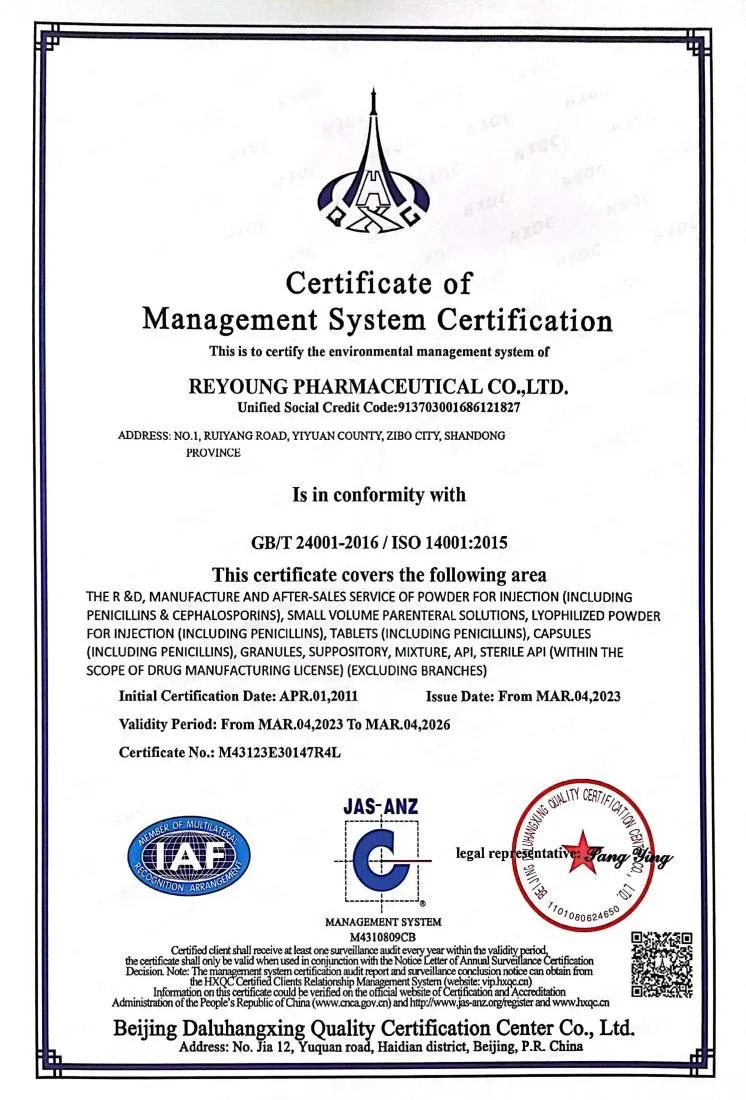
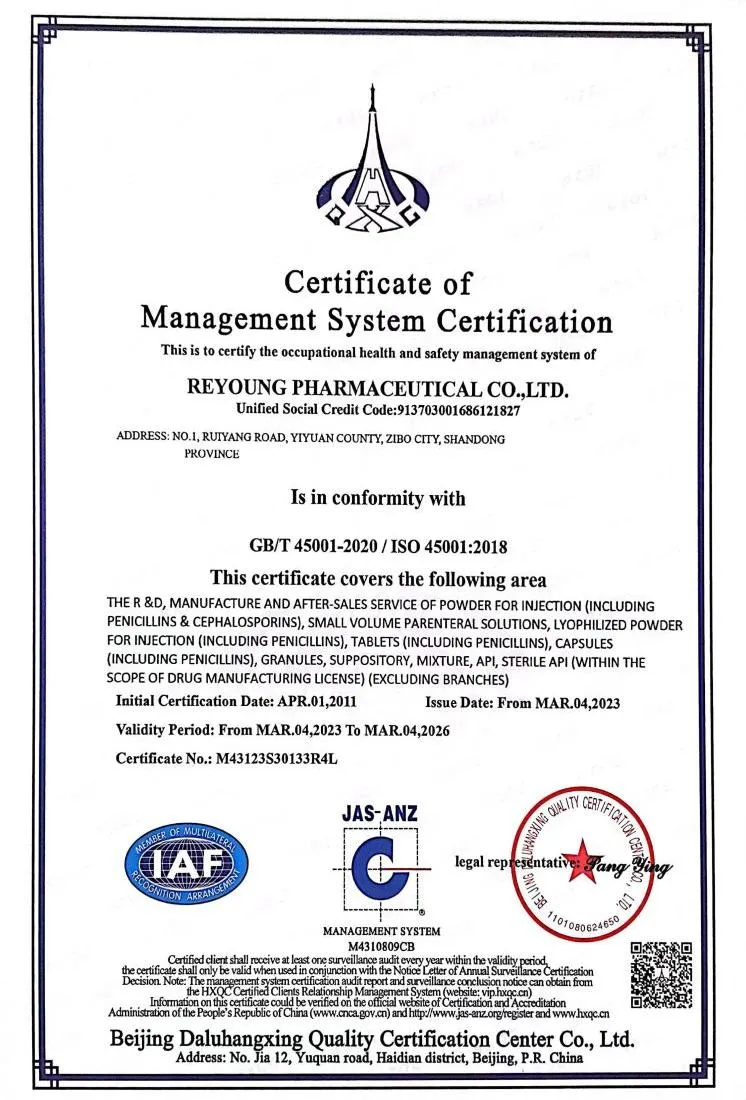
Our Certifications
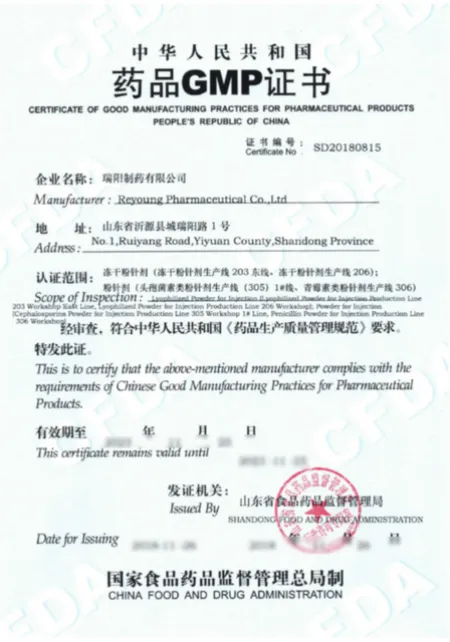
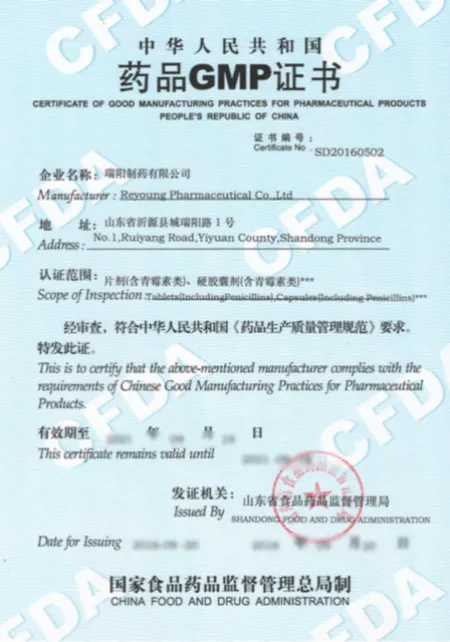
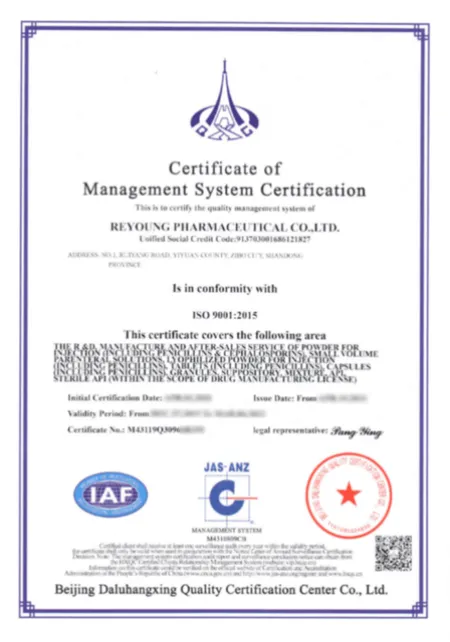
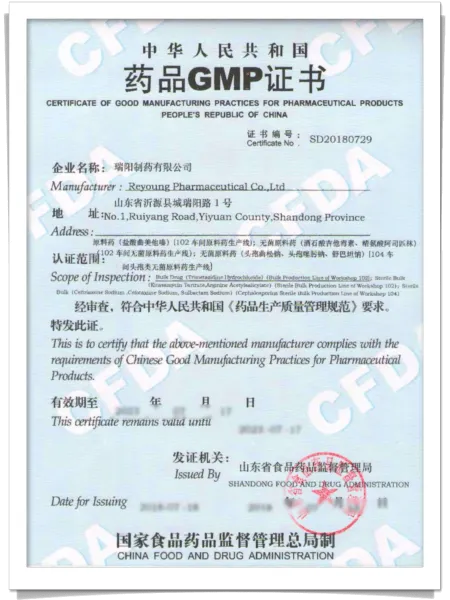
All the workshops have been passed the cGMP. Reyoung also pass ISO system certificates. Reyoung also passed the overseas audit like PIC/S GMP.
Our Factory
Reyoung consists of 3 factory sites (covering an area of 1 million m2), possessing more than more than 30 workshops (9 categories, and 400 strengths) .
Credit Enterprise
Reyoung Pharmaceutical Co., Ltd., established in 1966, is a modern comprehensive pharmaceutical company. Reyoung is given the title of National Trustworthy Company for Contract and Credit, Grade AAA Credit Company and Credit Company of Shandong Medical Industry.
Business Philosophy
Reyoung inherits the mission "Reyoung Pharma., Benefit the public", insists the business concept "Innovation is the basis, Product quality is first". Never stop exploration and innovation, forging ahead with determination, and realizing the sustainable healthy development.
-
![Sterile Water for Injection]() Sterile Water for InjectionSterile Water for Injection is a pharmaceutical-grade solution available in 2ml, 5ml, and 10ml vials. It is used solely for reconstituting certain medicinal products and is administered via...read more

Specifications
|
Classification by intended use |
Name of FUJIFILM Wako specification |
Official Specification |
General-purpose Solvent |
|||||
|
Methanol |
Ethanol |
Acetone |
Acetonitrile |
Tetrahydrofuran |
||||
|
For general use |
Wako 1st Grade |
〇 |
〇 |
〇 |
〇 |
〇 |
||
|
Guaranteed Reagent |
〇 |
〇 |
〇 |
〇 |
〇 |
〇 |
||
|
Wako Special Grade |
〇 |
〇 |
||||||
|
Specific use |
For Instrumental Analysis |
For HPLC |
〇 |
〇 |
〇 |
〇 |
〇 |
|
|
For LC/MS |
〇 |
〇 |
〇 |
|||||
|
For GPC |
〇 |
|||||||
|
For QTofMS |
〇 |
〇 |
||||||
|
For the Japanese Pharmacopoeia General Tests (for Liquid Chromatography) |
〇 |
〇 |
〇 |
〇 |
||||
|
For Spectrochemical Analysis |
〇 |
〇 |
〇 |
〇 |
〇 |
|||
|
For NMR |
〇 |
〇 |
〇 |
〇 |
〇 |
|||
|
For Preparative Chromatography |
〇 |
〇 |
||||||
|
Concentration 5000/300 |
〇 |
〇 |
〇 |
〇 |
〇 |
|||
|
For Measurement of Hazardous Substances and Environmental Contaminants |
For Boron Determination |
〇 |
||||||
|
For Dioxin Analysis |
〇 |
〇 |
〇 |
|||||
|
For Trihalomethane Analysis |
〇 |
|||||||
|
For Tiuram Analysis |
〇 |
|||||||
|
For PFOS-PFOA Analysis |
〇 |
〇 |
||||||
|
For Aldehyde Analysis |
〇 |
|||||||
|
For Environmental Analysis |
〇 |
〇 |
〇 |
〇 |
||||
|
For Vinyl Chloride Monomer Analysis |
〇 |
|||||||
|
For RoHSⅡ |
〇 |
〇 |
〇 |
|||||
|
For Organic Synthesis |
For Organic Synthesis |
〇 |
〇 |
〇 |
〇 |
〇 |
||
|
For Nucleic Acid Synthesis |
〇 |
|||||||
|
For Biochemistry |
Super Special Grade |
〇 |
〇 |
|||||
|
For Proteomics |
〇 |
|||||||
|
For Cell Culture |
〇 |
|||||||
|
For Molecular Biology |
〇 |
〇 |
||||||
|
For Drug Testing |
Japanese Pharmacopoeia |
〇 |
〇 |
|||||
|
For Medicine Test |
〇 |
〇 |
〇 |
|||||
|
High-purity reagent |
Infinity Pure |
〇 |
〇 |
〇 |
〇 |
〇 |
||
|
For Electronics Industry |
〇 |
〇 |
〇 |
|||||
|
Other |
For Chromatography |
〇 |
〇 |
|||||
|
For Determination of Wetting Tension |
〇 |
〇 |
||||||
Physical Parameters

Advantages of Solvents
High Solvency: Solvents can effectively dissolve a variety of substances, including solids, liquids and gases. This makes the solvent in the chemical, industrial, pharmaceutical and other fields are widely used, such as the preparation of solutions, extraction of active ingredients.
Solvency Diversity: Solvent solvency ability is manifested in its ability to cope with a variety of different types of substances. In chemical experiments, solvents are often used to dissolve reactants to make the reaction more efficient. In industry, solvents are used to extract and separate components of mixtures. In the pharmaceutical field, solvents are used to prepare drug solutions, which make it easier to take drugs and realize their effects.
Easy To Dispose Of And Recycle: Many solvents have good recyclability, which helps reduce environmental pollution and minimize waste of resources. Some solvents can be recycled after use through simple treatment, which not only reduces disposal costs, but also reduces the burden of waste solvents on the environment.
Conserve Raw Materials And Improve Production Efficiency: Because solvents can help to efficiently extract and separate substances, the use of solvents in industrial production can significantly save raw materials and improve production efficiency. For example, solvents play a key role in the production of products such as coatings, adhesives and cleaners, allowing them to work efficiently in smaller doses.
Types of Solvents

Non - Polar solvent
• Pentane - Pentane is a five-carbon chain organic compound. It has a low dielectric constant. Its dipole moment is zero. It does not act as a good solvent for charged species.
• Hexane - Hexane is a six-carbon chain organic compound. It has a low dielectric constant. Its dipole moment is zero. It does not act as a good solvent for charged species.
• Toluene - Toluene is an aromatic organic compound. It has a low dielectric constant. Its dipole moment is 0.34D. It does not act as a good solvent for any charged species.
• Chloroform - Chloroform is an organic compound. It has a low dielectric constant. Its dipole moment is 1.04D. It does not act as a good solvent for charged species.
Polar solvent
• Water - Its chemical formula is H2O. It is a polar protic solvent. It is also called a universal solvent. In various reactions, water plays the role of a solvent. Its dielectric constant is 80. The dipole moment of water is 1.85D. Water as a solvent example- water's ability to disrupt molecular structures to form solutions, makes it a valuable tool for organisms at the cellular level. Water as a solvent example will help you to get a clear understanding of the concept of polar solvents.
• Methanol - It is a polar organic compound. Its molecular formula is CH3OH. Its dielectric constant is 33. It has a high dipole moment of around 1.70 D.
• Acetic Acid - It is a polar organic compound. Its molecular formula is CH3COOH. Its dielectric constant is 6.2. It has a high dipole moment of around 1.74 D.
• Ethanol - Ethanol is a polar organic protic solvent. Its molecular formula is CH3CH2OH. Its dielectric constant is 25. It has a high dipole moment of around 1.69 D.
• Ammonia - Ammonia is a polar organic protic solvent. Its molecular formula is CH3CH2OH. Its dielectric constant is 25. It has a high dipole moment of around 1.40 D.

Application of Solvents
Solvents in paints and Coatings: In the use of paints, solvents are used to dissolve or dissolve the components used in paint formulations, the purpose of this use is to make the desired paint consistency when used and to avoid lumps from the paint. Another example of using solvents is Glycol ether esters which is added to several spray paints to prevent them from drying out in the air.
Solvents In Ink: Ink is used to print everything from magazines to packaging and food labels that are applied correctly, to get the right results. In the use of ink, the solvent used is a hydrocarbon solvent. Toluene is a solvent used as an ink solvent in a special type of magazine printing, because it evaporates fast enough to prevent stains and residual toluene is easily recycled.
Solvents In Personal Care Products: Many cosmetic products rely on solvents to dissolve ingredients and make the mixture work well. One example of Solvents used is in lotions, powders and shaving creams to provide the consistency that is appropriate for the product. An example of a solvent used in personal care is Ethanol, this solvent is used by perfume manufacturers as the solvent of their choice because of its low odor. The low boiling point of ethanol means that the solvent evaporates quickly and is not left on the skin. Besides ethanol, another solvent used is ethyl acetate or acetone used in nail polish and because of its fast drying. It is also used in liquid nail polish remover, and its high solvability means it can be easily removed from the nail.
Solvents In Cleaning Products: One of the solvents used for cleaning products is glychol ethers which are very effective as active components of heavy glass, floors, and other hard surface cleaning formulations. These solvents have good water compatibility, high solvency for greases and oils and good biodegradability. Besides that another solvent used is Isoparaffin used to dry clothes. This solvent is used because of its low odor, good health and environmental profile, safe handling characteristics and excellent cleaning efficiency.
Solvents In Health: Solvents are used in hundreds of pharmaceutical products and solvents contribute to many drugs that people use today, from penicillin to aspirin, cough syrups, and topical ointments. One example of a solvent used in health is that Butyl acetate is used to purify penicillin by keeping impurities in solution while penicillin is selectively removed from the reaction mixture by extraction.
Production Process of Solvents
The raw materials for solvent refining are generally plant or animal extracts, which require preliminary treatment and preparation. First, the raw material needs to be crushed and sieved to remove the impurities and unwanted parts from it to make it more suitable for solvent extraction. Then it is added to the extractor, the appropriate amount of solvent is poured in and the extraction is started.
Extraction process, you need to control the extraction temperature and time, so that the solvent can fully extract the active ingredients in the raw material, and reduce the damage to the raw material. After extraction, through the separator will be separated from the solution to get the raw material solution.
Through the distiller, the raw material solution is separated to remove the impurities and unwanted components, so that the final product is more pure. This step requires good control of temperature and pressure to ensure the separation effect.
The purpose of washing is to remove the solvents and impurities left in the product after distillation to make the product purer and meet the quality standards. Washing needs to control the quality and amount of water to avoid adverse effects on the product.
Put the washed products into the dryer, control the temperature and humidity so that it gradually lose water to achieve the appropriate moisture content. The dried products can be directly packed or further processed.
Certificate

Packaging
|
Storage |
Store at temperatures below 30°C in a dry place, protected from light. |
|
Packaging |
50 Vials in a box. |
|
Validity |
Three years |
|
Manufactured by |
Reyoung Pharmaceutical Co.,Ltd. |
|
MOQ |
100000 Vials |
|
Qualification Certificate |
COPP,GMP |
Our Customization Process
Select A Project
Please choose the product you need based on the existing products
Project Analysis
We will analyze your needs based on the product you have chosen and provide you with a suitable proposal
Deliver Sample
After you confirm the product, we will deliver the sample to you as soon as possible
Order Confirmation
We have a formal and detailed order format
FAQ
We're professional solvents manufacturers and suppliers in China, featured by quality products and good price. Please feel free to wholesale solvents made in China here from our factory. Contact us for more details.
Sterile Water For Injection